
1. Why 800V Changes the Charging System
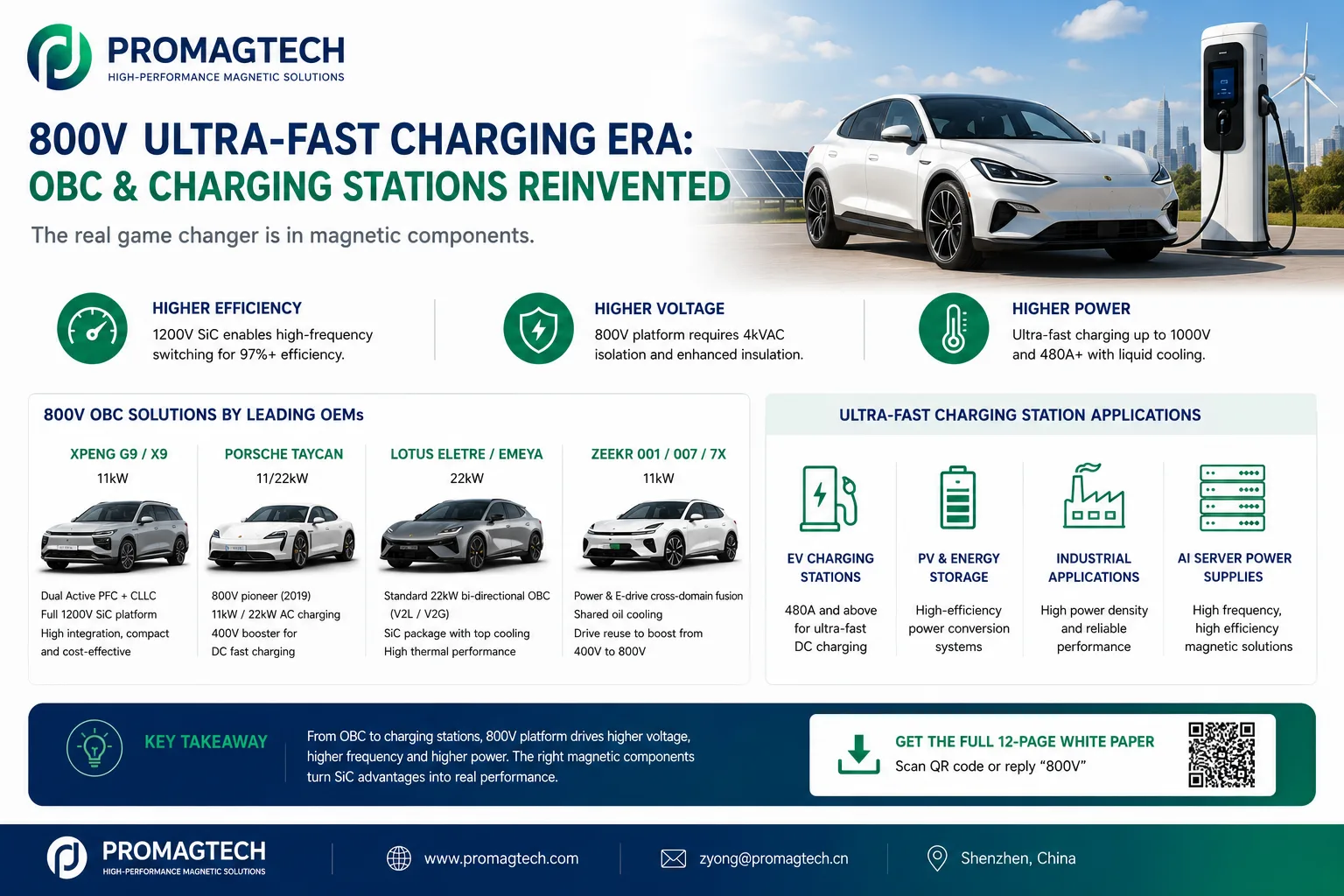
Moving from 400V to 800V halves current for the same power. The white paper uses this system shift to explain lower conduction loss, lighter cables and faster charging, while also showing why every energy-path component must be reviewed again.
2. What Changes in the Power Electronics
Many 800V OBC designs evaluate 1200V SiC MOSFETs for voltage margin and switching-loss reduction; the final device and frequency depend on the converter design.
Higher frequency can shrink inductors and transformers, but only when core material, flat-wire or planar winding and insulation design keep pace.
The supplied paper uses a 4kV-class hi-pot level as a reinforced-isolation design example; the final requirement follows the project safety file.
Some DC fast-charging systems span wide output-voltage ranges, while high-current cable assemblies may require liquid cooling after connector, duty-cycle and thermal review.
3. Standards and Validation Boundary
The paper references IEC 61851 / 62196, ISO 6469-3 / 17409, IEC 60664-1 insulation coordination, CISPR 25 EMC and the AEC-Q200 stress-test qualification framework for passive components. These references do not represent qualification of a ProMagTech part. Qualification evidence must be confirmed for the specific part number and customer program.
4. Frequently Asked Questions
These answers summarize the engineering topics in Section 11 of the downloadable white paper and add project-specific validation boundaries.
Does an 800V OBC have to use silicon carbide (SiC)?
Many 800V OBC designs use 1200V SiC devices to provide suitable voltage margin and reduce switching loss. Device rating, topology and achievable efficiency remain project-specific and must be confirmed by system simulation and testing.
What dielectric withstand does an 800V isolation transformer need?
A 4.0 kVAC, 1-minute primary-to-secondary hi-pot and an 8 mm creepage distance are useful design examples, not universal limits. Final values depend on working voltage, insulation class, pollution degree, material group, altitude and the project safety file.
Why do 800V ultra-fast charging stations use liquid cooling?
At very high charging current, cable losses and handling weight can make liquid cooling appropriate. The threshold depends on connector rating, cable design, duty cycle, ambient temperature and station architecture.
Should the isolation stage use LLC or CLLC?
For bidirectional V2G or V2L operation, CLLC is one candidate because its symmetric resonant tank can support both power-flow directions. Selection between LLC, CLLC and other topologies depends on the required gain range, control strategy and operating envelope.
What advantages do flat-wire inductors have over round wire?
Flat wire can improve window utilization and reduce DCR within a comparable winding envelope. Temperature rise and AC loss still depend on conductor dimensions, frequency, winding arrangement, core loss and cooling, so the result must be confirmed on the sample.
Can PROMAGTECH customize magnetics for an 800V OBC or charging module?
ProMagTech can review custom PFC inductors, CLLC transformers, resonant inductors and common-mode chokes against the supplied topology and safety requirements. Validation items and deliverables are defined by the approved sample and test plan and may include inductance, DCR, hi-pot, loss and temperature-rise records.
Download the PDF White Paper
Download the English 800V EV Charging Systems white paper for engineering review and supplier discussion.
Download PDF Data